
My AI research develops machine learning and deep learning methods for healthcare and biomedical data, centered on medical foundation models, model compression, medical image segmentation, and large language models. As first author, I developed weight group-wise post-training quantization for medical foundation models, and I contributed to generalized post-training quantization of a medical image segmentation foundation model, published in Medical Image Analysis. My related work includes uncertainty-aware cardiovascular image segmentation, case-based medical question answering with large language models, and neural radiance fields for medical imaging. Throughout, I focus on methods that are efficient enough to deploy and reliable enough for clinical and biomedical use.
I have also contributed to collaborative projects in biomedical AI, including research on large language models for medical question answering and post-training quantization of medical foundation models.
Related Research
Weight Group-wise Post-Training Quantization for Medical Foundation Model
Medical foundation models can be computationally expensive to deploy because of their large model size and memory requirements. This project investigates post-training quantization as a way to reduce computational and memory costs while preserving the performance of medical foundation models. I developed Permutation-COMQ, a post-training quantization approach that avoids backpropagation and hyperparameter tuning by using dot-product and rounding operations. The method also incorporates a weight-aware reordering strategy to reduce accuracy degradation caused by channel-wise scaling while preserving the structure of model weights.
Focus: Medical foundation models · Model compression · Post-training quantization · Efficient AI
Methods: Distributed lag nonlinear models (DLNMs) · Quasi-Poisson regression · Threshold analysis · Stratified analysis
Status: Accepted to CVPR 2026 Workshop on AI for Medical Sciences (AIMS)
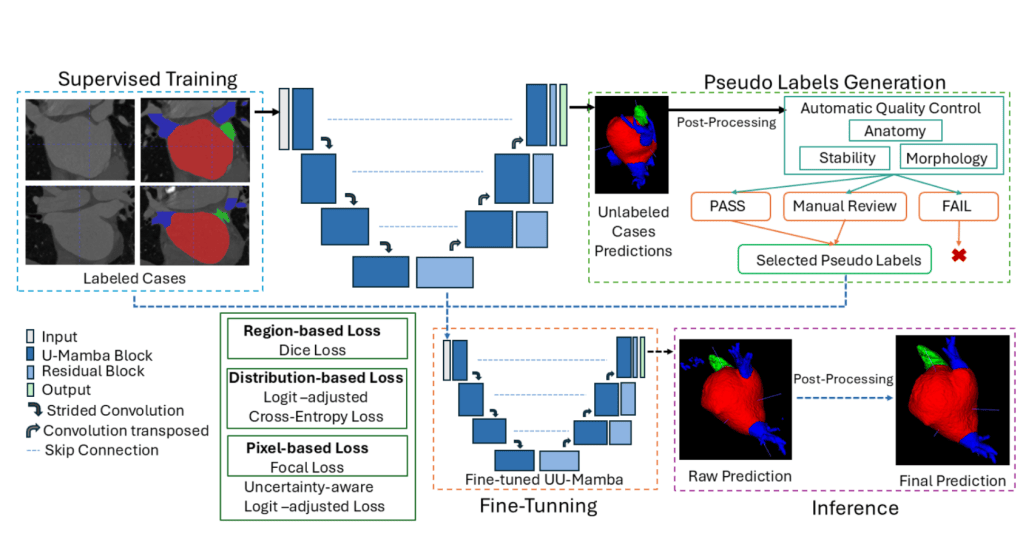
Progressive Optimization of UU-Mamba for Left Atrial Multi-Structure Segmentation in CT
Accurate segmentation of left atrial structures from cardiac CT is important for assessing atrial fibrillation and supporting catheter ablation planning, but automated segmentation is challenging because of severe class imbalance, anatomical variation, and limited labeled data. In this project, I developed a quality-controlled semi-supervised framework based on UU-Mamba for multi-structure cardiac CT segmentation. The approach combines logit-adjusted cross-entropy loss to address class imbalance with a quality-control framework for evaluating pseudo-labels based on morphological characteristics, anatomical consistency, and prediction stability. Reliable pseudo-labels were then selected for model fine-tuning.

